

Dear reader, I went to audio college, and I’ll tell you something most graduates won’t: I learned a lot. I also had to unlearn a lot, too.
In hindsight, that second part cost me years.
I’ve been mixing professionally now since 2010. I’ve learned in commercial studios alongside engineers whose records you own. And I now teach mixing for a living. So I’ve considered this question from every side: as a student, as a working engineer, and as an educator.
Is audio engineering school worth it?
Is audio engineering school worth it?
My honest answer is: for most people reading this, no. Audio school is not worth it. But not for the reasons YouTube or REDDIT comment sections give you. The real answer comes down to maths, and a problem with the education model itself that nobody inside the industry wants to say out loud.
When you go to audio school, what are you actually buying?
What an audio degree actually costs
These are real 2026 figures, not scare numbers:
- Full Sail University (USA): around $86,000 USD for the Bachelor of Science in Music Production. The online Associate degree runs about $36,000.
- Abbey Road Institute (Sydney): AUD $54,350 for the Diploma of Music Production.
- JMC Academy (Australia): roughly AUD $11,984 per trimester for domestic students. That’s over $35,000 a year.
- RMIT: between AUD $12,250 and $19,290 for a diploma.
- Berklee Online: $33,000 to $38,000 USD for the one-year Master of Music in Music Production – and you need an existing degree just to enrol.
In Australia, most of this gets deferred through FEE-HELP or VET Student Loans. That’s not a discount. That’s the sticker shock moved into your future, where it sits indexed against inflation while you try to build a career in an industry famous for not paying juniors.
What you get for the money
When asking, “Is audio engineering school worth it?”, I want to be fair here, because the criticism only means something if it’s honest.
Audio college gave me real things. Structured fundamentals. Deadlines. Access to rooms and consoles I couldn’t afford. Classmates, some of whom became colleagues. A piece of paper.
If you learn best with external structure and you have the money sitting around, those things have value. I’m not going to pretend otherwise.
But here’s what I noticed, both as a student and in the years after.
The three problems nobody tells you about
1. The skills don’t transfer to where you’ll actually work
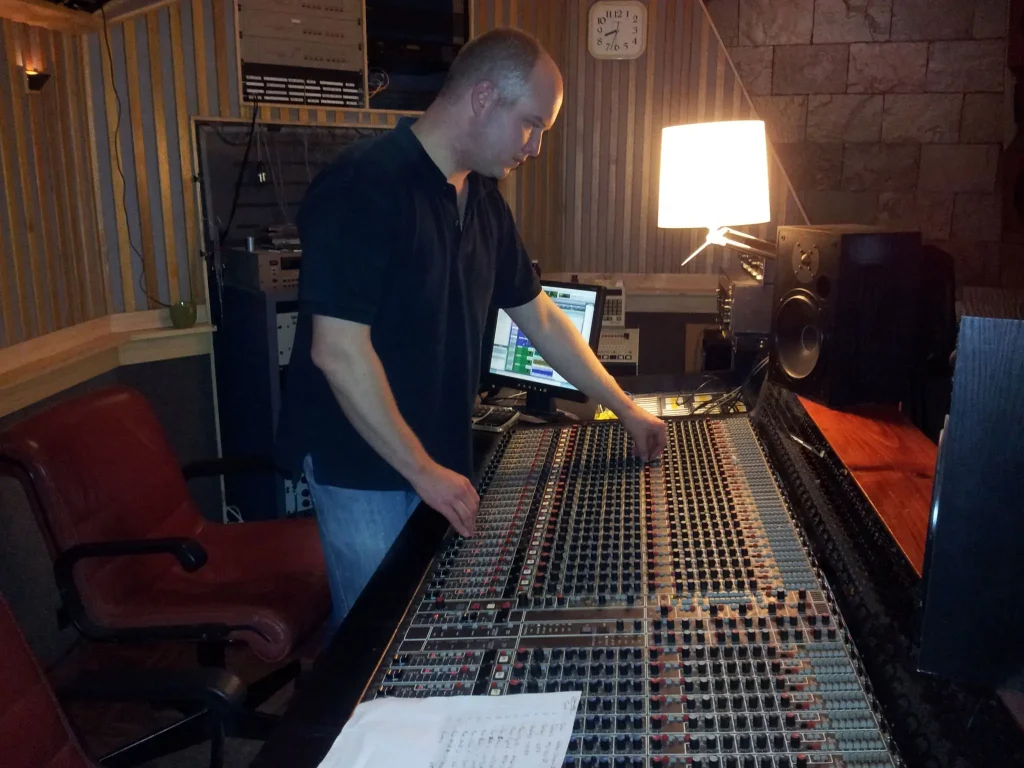
You will spend a meaningful part of your degree learning signal flow on a large-format analogue console. It feels professional. It feels like the real industry.
But then you graduate, and the real industry is a laptop, an interface, and an untreated bedroom. Yours, and your clients’.
The console skills aren’t useless. But they’re answers to questions you won’t be asked. The questions you will be asked – why does my mix sound muddy, why does the low end vanish in the car, why doesn’t this translate – those come down to acoustics, phase, gain structure, ear fatigue, psychoacoustics and more.
2. The accreditation tax
Accredited programs have to satisfy government education standards. That means mandatory modules that have nothing to do with making records sound good. You pay for those modules. You sit through those modules. The clock runs either way.
This isn’t the school being lazy. It’s structural. An accredited diploma cannot just teach you mixing, even if your instructors wanted to. At the end of the day, you’re paying tens of thousands of dollars partly for paperwork.
3. The unlearning
Two examples of unlearning spring to mind from my time at college.
1 – Conservative Moves
Teachers said not to boost or cut frequencies more than +/-3dB and to mix to a “comfortable” loudness level.
Really, I had no idea what “comfortable” was. I was also working with sub-par material that could have benefited greatly from more heavy-handed EQ moves – but I didn’t have the skills I have now to get away with the bolder moves required.
The result? My mixes sounded bland – they had no personality, unlike some of my favourite records. Some of my mixes were so quiet you could hear the stereo hiss from needing to turn up so loud (to hear them properly!)
Years later I learned to build optimal loudness in a smarter way, and started using EQ – and other tools – more freely, without arbitrary restrictions attached to every decision. But it took me years to shake off those bad habits I had learned at audio school.
Mixing deserves a special approach that few lecturers appear to get right or understand. Institutions teach what’s testable. But real mixing is decision-making under ambiguity. Every choice is a strategy made in context, and two great sounding mixes can contradict one another. That’s the real-world nature of mixing, but that doesn’t grade well, and so consequently doesn’t get taught well.
You graduate knowing rules. Then you spend years discovering which rules were actually principles, and which were just habits someone wrote into a curriculum in 1998.
2 – The “Fix It In The Mix” Mentality
Thankfully, in my 2nd year I had my first genuine “aha” moment, and it was a good one. Despite my naivety at the time, my instincts were spot on, and the ‘unlearning’ started happening during my remaining time at audio college.
Recording sessions were always fun. You set up microphones, got the headphone blend for the musicians, and off you went. No pre-planning. No thought given to optimal band placement or microphone positioning. Just set it up and get it working and (hopefully) enjoy the music.
Later, we would listen back to the recordings, realising we’d have to pull the “real” sound out during mixing. Everyone just accepted this: that you had to “fix it in the mix”. They didn’t know any better, and neither did our teachers, it appears.
One day, in an inspired moment, I said to a fellow student, “How about instead of fixing it later during the mix, why don’t we try to capture the mix during the recording phase?” They laughed and said I was crazy. The flow-on effect – from recording to mixing – had never really been explicitly discussed or pointed out. But it was clear to me that if we wanted to get better mixing results, we’d need to look further upstream at improving the raw recordings.
So, I persisted and was able to convince my colleague how I thought it could work. I put this to good use on my next audio college recording projects.
My instincts led to a real breakthrough recording session that year – one of the hardest I’d done, but also one of the most rewarding. Instead of musicians being recorded individually and then layering tracks, I planned a high-risk live session with everyone playing together in the same room. The band were great live, so I just needed to figure out how to work with that.
The musicians performed better – knowing one mistake would ruin someone else’s great performance. It really piled on the pressure (in a good way) and elevated the recordings. The planning, the redundancies, the mic choices & positions, the musician layout in the room – it really paid dividends.
Subsequently, it produced one of my best mixes – with nothing prior coming close. I started realising that there was a lot more to this craft than our teachers were teaching. No more fixing while mixing.
The return on investment, in plain numbers
If you run the maths the way you’d run it for any other purchase, is audio engineering school worth it?
Say you take the Abbey Road Sydney diploma at $54,350. Junior studio roles, where they exist at all, pay modestly, and most graduates end up freelancing anyway – competing for the same independent artists as every self-taught mixer with a SoundCloud link.
For that degree to beat the alternative, it has to deliver $54,350 more value than spending a fraction of that on focused education and putting the rest toward acoustic treatment, monitoring, and time spent actually mixing. Room treatment and mixing hours move your results more than any certificate. That’s not opinion. That’s where the bottleneck physically is: your room and your repetitions.
I have never once been asked for my qualification by a client. Not once in 15 years. Clients ask to hear your work. That’s the entire interview.
Who should actually go
If you find yourself still wondering, is audio engineering school worth it for me? Honesty cuts both ways, so here’s who I’d still point toward a formal program:
- You want a broadcast, post-production, or live venue employee role where HR filters by qualification.
- You need a structured environment to function, and self-direction genuinely doesn’t work for you.
- Someone else is paying, and the debt isn’t real to you.
If that’s you, go, and squeeze every drop out of the facilities. For everyone else – the musicians and self-taught engineers trying to make their own records sound commercial – the degree is solving a problem you don’t have, at a price you can’t justify.
What I’d do instead
If I were starting today, I’d spend the money in this order:
- Learn the principles properly. Acoustics, phase, gain staging, dynamics, psychoacoustics – the why behind every move, not plugin recipes. This is the part a degree should give you and mostly doesn’t.
- Fix the room before the gear. Measurement and treatment beat new monitors every time. Get it right at the source.
- Mix constantly. Free multitracks exist in abundance. Repetition with understanding is the entire game.
That order matters. Most people invert it: they buy gear first, grab techniques off YouTube second, and never touch the principles. Then they wonder why they’ve plateaued.
The understanding part is exactly why I built the Level Up Pro Mixing System. It’s the education I wish I’d been handed: the principles from a formal audio education, minus the accreditation tax, the console nostalgia, and the debt – plus the things I only learned from 15 years of client work. I’m not going to oversell it here. If the logic of this article makes sense to you, the course is that logic, taught in full.
The bottom line
Is audio engineering school worth it? If you need the credential for an employee role, maybe. If you want to mix records that sound commercial, no. The maths doesn’t work, the skills don’t transfer, and the most important things – the physics, the decision-making, the why – are exactly the things the institutional model is worst at teaching.
I say that as someone who went. The education wasn’t worthless. It was just wildly overpriced for what transferred, and silent on what mattered most.
So, I ask you: Is audio engineering school worth it?
